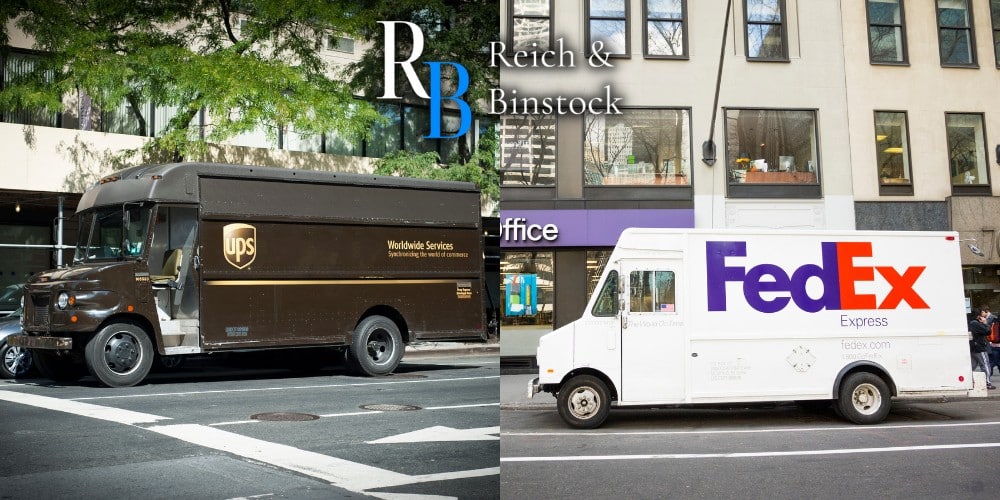
In 2026, the modern economy runs on instant gratification. We click "Buy Now," and expect a package on our doorstep in 24 hours. To meet this insatiable demand, companies like FedEx, UPS, and increasingly Amazon, have flooded American roads with fleets of delivery trucks.
But this convenience comes at a bloody cost.
Delivery drivers are under immense pressure. They are tracked by GPS, monitored by AI cameras, and forced to meet grueling quotas. "The Algorithm" dictates their route, often forcing them to make dangerous left turns, park illegally, or speed through residential neighborhoods to save 30 seconds.
When a 20,000-pound delivery step-van crashes into a family sedan or strikes a pedestrian, the results are catastrophic.
For the victim, the legal battle that follows is even more daunting. Suing FedEx or UPS is not like suing a neighbor who dented your bumper. You are going up against multi-billion dollar corporations with dedicated "Risk Management" departments whose sole job is to deny your claim. They will use every trick in the book—from the famous "Independent Contractor" defense to hiding driver logs—to pay you nothing.
This comprehensive guide is your weapon. We will expose the specific legal strategies needed to sue delivery giants. We will explain the critical differences between a UPS claim (Union employees) and a FedEx Ground claim (Contractors), and guide you step-by-step to a fair settlement.
Part 1: Know Your Enemy – The Structural Difference
Before you file a claim, you must know who you are actually suing. FedEx and UPS may look similar (big trucks delivering boxes), but legally, they are two different animals.
1. UPS (United Parcel Service): The Integrated Giant
UPS owns its brown trucks ("Package Cars") and directly employs its drivers. They are unionized (Teamsters).
-
The Legal Implication: If a UPS driver hits you, UPS is almost always directly liable under the doctrine of Respondeat Superior (Employer Liability).
-
The Money: UPS has a massive self-insured retention and layers of excess insurance. They have the money to pay, but they fight hard to protect their safety record.
2. FedEx Express vs. FedEx Ground (The Shell Game)
This is where it gets tricky.
-
FedEx Express: Drivers are usually employees (similar to UPS).
-
FedEx Ground: These drivers are often NOT FedEx employees. They work for small, independent trucking companies that contract with FedEx. The trucks say "FedEx," but the owner is "Bob’s Trucking LLC."
-
The Defense Trap: When you sue FedEx Ground, they will file a motion to dismiss, claiming, "We didn't hire the driver; the independent contractor did."
-
The Strategy: Your lawyer must sue both FedEx (for negligent selection/control) and the independent contractor (for the crash).
3. Amazon Logistics (The DSP Model)
Though not in the title, Amazon fits here. Amazon uses "Delivery Service Partners" (DSPs). Like FedEx Ground, these are separate LLCs. Amazon aggressively denies liability for DSP crashes, though recent court rulings in 2025/2026 are starting to pierce this veil.
Part 2: The "Golden" Insurance Policies
Why do lawyers fight so hard for these cases? Because the insurance policies are enormous.
The Federal Minimum
Any commercial vehicle over 10,000 lbs crossing state lines must carry at least $750,000 in liability insurance. But major carriers carry much more.
The UPS/FedEx Standard
-
Policy Limit: Typically $1,000,000 per accident (Primary).
-
Excess/Umbrella: These corporations usually carry $50 Million to $100 Million+ in excess coverage.
-
What this means for you: Unlike a car accident where the driver might only have $30k insurance, here, there is effectively "unlimited" money available if your injuries warrant it. You will never hit a policy cap in a standard injury case.
Part 3: Step-by-Step Guide to Filing a Claim
If you are hit by a delivery truck, the company knows about it instantly (telematics). They are building their defense before the police arrive. Here is how you build your offense.
Step 1: Secure the "Business Card" Evidence
At the scene, do not just get the driver's license. You need to know the specific corporate entity.
-
Look at the Door: On a FedEx truck, look for text that says "Operated by [Name of Contractor]." Take a photo. This is the true defendant.
-
DOT Number: Photograph the US DOT number on the side of the truck. This allows your lawyer to look up their safety history.
Step 2: The "Spoliation Letter" (Day 1 Priority)
Delivery trucks are high-tech data centers. They have dashboard cameras (like Lytx DriveCam), GPS trackers, and handheld scanners.
-
The Danger: Companies overwrite this data quickly (sometimes in 72 hours).
-
The Action: Your lawyer must send a certified Spoliation Letter immediately. This legal document puts them on notice to preserve:
-
Dashcam footage (inward and outward facing).
-
The driver’s scanner data (proves if they were distracted/interacting with the device).
-
GPS speed logs.
-
Text messages from Dispatch.
-
Step 3: Medical Triage
Go to the ER. Delivery trucks have heavy steel bumpers that override passenger car crumple zones. "Whiplash" often turns out to be a cervical fracture or disk herniation.
-
Documentation: You need "Objective Medical Evidence" (MRI, CT Scan) to force a high settlement.
Step 4: File the Claim (But Don't Talk)
Your lawyer will open a claim with the insurance carrier (e.g., Liberty Mutual, AIG, or the company's internal TPA - Third Party Administrator).
-
The Rule: Do NOT give a recorded statement. The adjuster will ask, "How fast were you going?" or "Did you see him coming?" They are fishing for "Comparative Negligence" to reduce your payout.
Part 4: Common Causes of Negligence (How to Prove Fault)
To win, you must prove the driver violated the "Standard of Care."
1. The "Left Turn" Trap
Delivery routes are optimized for right turns (to save fuel and avoid idling), but when drivers make left turns across traffic to rush a delivery, accidents happen.
-
Legal Argument: Failure to yield right of way; blind spot negligence.
2. Illegal Parking / Blocking Traffic
Drivers often park in bike lanes or double-park to run a package to a door.
-
The Scenario: You swerve to avoid the illegally parked truck and hit another car.
-
Liability: The delivery company is liable for creating the hazard ("Proximate Cause").
3. Fatigue and Quotas
During "Peak Season" (Christmas), drivers work insane hours.
-
Evidence: We subpoena the driver's timesheets and scanner logs. If he made 200 stops in 10 hours, he was rushing. If he violated "Hours of Service" rules, the company is negligent.
4. Unsecured Cargo
If a package falls out of the truck (doors left open) or the truck rolls over because it was top-heavy.
-
Liability: Negligent loading practices.
Part 5: Negotiating the Settlement (The "Lowball" Phase)
FedEx and UPS use sophisticated software to value claims. They will not pay fair value voluntarily.
The "Nuisance Value" Offer
They might offer $5,000 to "make this go away." Reject it. This doesn't even cover future physical therapy.
The "Pre-Litigation" Offer
Once you finish medical treatment, your lawyer sends a Demand Package.
-
Expectation: They will likely offer 40-50% of the case value. They are testing if you are desperate for cash.
The "Litigation" Value
Real money is offered after you file a lawsuit. Why?
-
Discovery: Once you sue, you get to depose the Safety Director and see their internal training manuals. Corporate giants hate exposing their internal secrets. They often settle to keep their "dirty laundry" (like hiring drivers with bad records) out of the public record.
Part 6: Average Settlement Amounts (2026 Data)
What is a FedEx/UPS case worth?
-
Minor Injury (Soft Tissue, Fully Recovered): $25,000 - $60,000.
-
Moderate Injury (Broken Bone, Herniated Disc): $100,000 - $400,000.
-
Severe Injury (Surgery, Career Ending): $750,000 - $2,000,000.
-
Catastrophic (Brain Injury, Paralysis, Death): $5,000,000 - $20,000,000+.
Note: These figures assume clear liability. If you were partially at fault, reduce accordingly.
Part 7: The "Statutory Employer" Doctrine (Breaking the Contractor Shield)
If you are hit by a FedEx Ground contractor, their insurance might "only" be $1 million. If your injuries are worth $5 million, how do you get FedEx to pay the rest?
Your lawyer uses the Statutory Employer argument.
-
The Argument: Since FedEx displays its logo (Placard) on the truck and controls the driver (tells them what to wear, where to drive, when to arrive), FedEx is the "Statutory Employer" under federal law, regardless of what the contract says.
-
Success Rate: Courts are increasingly accepting this, making FedEx vicariously liable for its contractors.
Conclusion: You Are Not Suing a Driver; You Are Suing a Logistics Algorithm
When you fight FedEx or UPS, you are fighting a system designed to prioritize speed over safety. The driver who hit you was likely exhausted, under-trained, and managed by an algorithm that punished him for slowing down.
Filing a claim is not just about getting money for your medical bills. It is about holding these corporate giants accountable. It forces them to fix their safety protocols so the next family isn't destroyed.
Your Action Plan:
-
Identify the entity (Express vs. Ground vs. UPS).
-
Preserve the Dashcam data immediately.
-
Hire a lawyer who has litigated against these specific companies before.
-
Be patient. Big settlements take time.
In the battle of David vs. Goliath, David needs a slingshot. Your lawyer and the evidence are that slingshot.
Frequently Asked Questions (FAQ)
Q: Can I sue Amazon if an Amazon Prime van hits me? A: Yes, but it is hard. You usually sue the "DSP" (Delivery Service Partner), which is a small LLC. However, lawyers are now successfully suing Amazon directly for "Negligent Control" because Amazon dictates every turn the driver makes via their app.
Q: What if the delivery truck left the scene (Hit and Run)? A: This happens often. Look for neighbors with Ring Doorbell cameras. Delivery trucks are GPS tracked. If you have the time and location, a lawyer can subpoena FedEx/UPS to identify which truck was on that street at that exact minute.
Q: Does UPS settle out of court? A: Yes, 95% of the time. They are a rational business. If the evidence shows they are at fault, they prefer to pay confidential settlements rather than face a jury verdict that generates bad PR.
Q: Can I claim lost wages if I am self-employed? A: Yes. It is harder to prove, but you can use tax returns, 1099s, and cancelled contracts to prove lost income.
Q: Who pays for my rental car? A: The trucking company's insurance should pay. However, they are slow. It is often faster to use your own insurance (if you have rental coverage) and let your insurer get reimbursed later.

